
Texas County Court Records After Arrest
The Texas County arrest-to-court path has several handoffs. The sheriff, city police, MSHP, or another agency may arrest and book a person. The jail record may show preliminary arrest charges and custody status. The Texas County Prosecuting Attorney then decides whether to file state-law charges. Once the charging document is filed and entered, the court record appears through the clerk and Case.net.
The Texas County jail inmate records page is the better place for current custody, bond by phone, release, or transfer questions. The Texas County jail mugshots page addresses booking photos. Court records after a jail arrest focus on the filed criminal case: charges, charge status, docket events, court dates, warrants, bond orders, and final disposition.
Missouri counties use the title Prosecuting Attorney rather than district attorney. Texas County Prosecuting Attorney Parke J. Stevens Jr. prosecutes state-law crimes from traffic tickets through serious felonies, and the office has exclusive jurisdiction over felony crimes committed in Texas County. Misdemeanor prosecution in unincorporated areas also flows through that office.
Find Texas County Court Records
Start with Missouri Case.net when charges may have been filed after a Texas County arrest. Case.net is the public court search portal for participating Missouri courts. The Texas County circuit clerk page says the clerk maintains court records and that Case.net gives public status information. It also gives a timing detail that matters: 25th Judicial Circuit searches show real-time data after the clerk enters it, while statewide participating-court searches may lag up to 3 hours.
- Open Case.net and search by litigant name if no case number is known.
- Choose the 25th Judicial Circuit or Texas County when possible to focus the search.
- Use a case number for the best match if the jail, court, or prosecutor has provided one.
- Open the case and read the charge list, docket entries, bond orders, and scheduled hearings.
- Compare the filed charges with the arrest or booking information, because they can differ.
The Texas County Circuit Clerk page describes the court divisions, Case.net public access, and the 25th Judicial Circuit timing point.
That local clerk source is important because it explains both where Texas County court records are maintained and why a statewide Case.net search may not update at the same speed as a local circuit search.
Texas County Case.net Fields
Case.net offers several public search paths. Use more than one when the name is common, when the arrest date is known but the case number is not, or when a first search shows no result. A spelling difference, middle initial, or delayed filing can change the results.
| Field Label | Type | Required | Options / Format Notes |
|---|---|---|---|
| Litigant Name | Text | Optional | Search by party or defendant name; use spelling variants. |
| Case Number | Text | Optional | Best exact match if known. |
| Filing Date / Date Range | Date | Optional | Useful when many people share a name. |
| Court / Circuit | Dropdown | Optional | Choose 25th Judicial Circuit or Texas County when possible. |
| Scheduled Hearings/Trials | Date/search mode | Optional | Finds upcoming court dates. |
| Judgment Index | Search mode | Optional | Separate court-search path for judgments. |
Charges Filed After Arrest
A jail arrest does not create a conviction. It starts a custody and review process. The prosecutor may file a complaint, information, or indictment depending on the case. The wording of the filed charge matters more than the short phrase a jail record may use at intake.
| Document | Who Uses It | What It Does |
|---|---|---|
| Complaint | Officer or prosecutor route, depending on case stage | States an alleged offense and can support early court action after arrest. |
| Information | Prosecuting Attorney | Formal prosecutor-filed charge used in many Missouri criminal cases. |
| Indictment | Grand jury process | Formal accusation through a grand jury, usually for more serious cases. |
The Texas County Prosecuting Attorney page explains the office's role in prosecuting state-law crimes, victim services, child support, bad checks, and county counsel work.
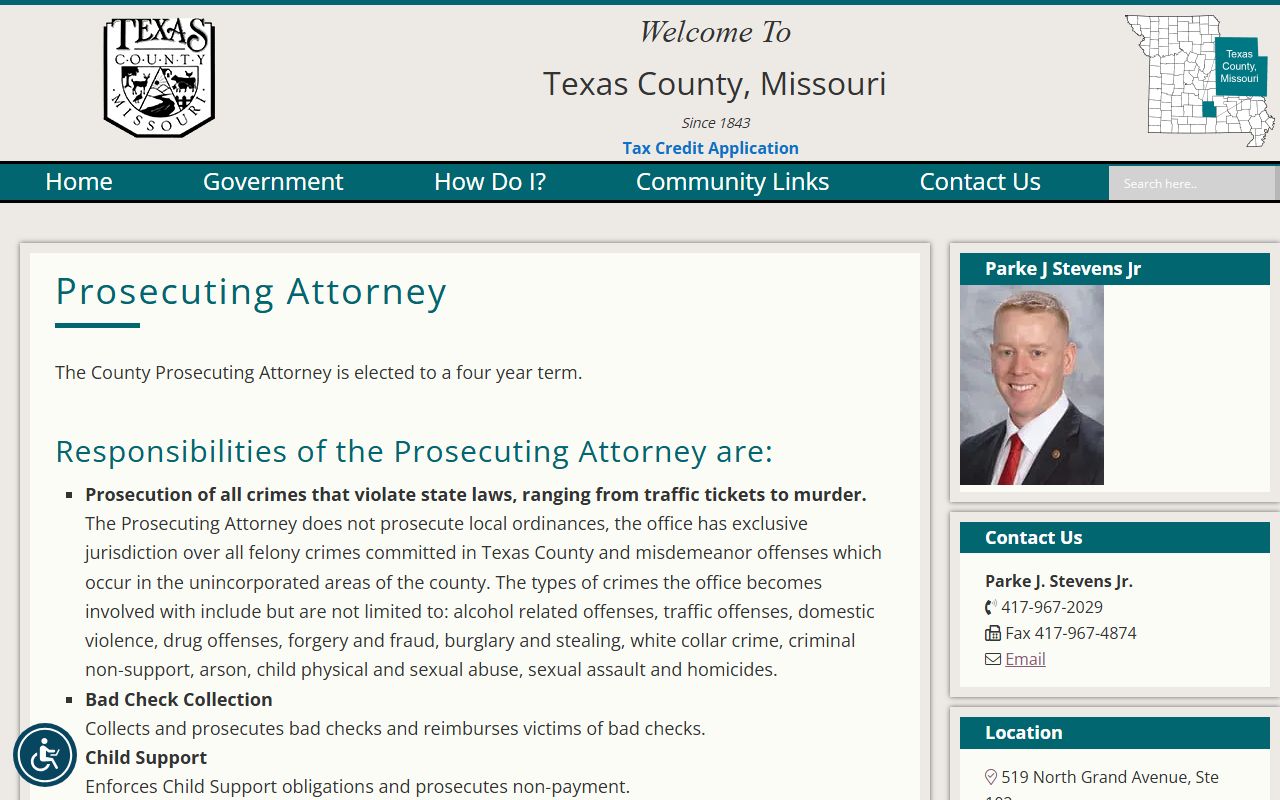
The prosecutor source helps explain why an arrest charge can change once the office reviews reports, evidence, witness statements, and legal elements.
Texas County Charge Status
Charge status tells where the court record stands after the arrest. Read the current status and the docket entries together. A dismissed count may sit next to a pending count. An amended charge may replace an earlier charge. A disposition may close one count while another count continues.
| Status | What It Means |
|---|---|
| Pending | The charge has not reached a final outcome. |
| Amended | The formal charge changed after filing. |
| Reduced | The charge was replaced with a lesser offense or level. |
| Dismissed | The charge ended without a conviction on that count. |
| Disposition | The court outcome for the charge or case. |
Case.net is not a mugshot source and is not a live jail bed list. It is the court case source after filing and clerk entry.
Bond Orders After Arrest
Texas County does not publish a local bond-posting procedure in the reviewed official pages. Bond may be set by warrant, by a judge, or at an early court appearance. The jail may know current custody and release status first. The court record may show the bond order after entry.
| Bond Type | How It Works |
|---|---|
| Cash bond | Money is deposited as ordered by the court or warrant. |
| Surety bond | A licensed bail agent may post bond under Missouri practice. |
| Own recognizance / PR | Release based on a promise to appear and follow conditions. |
| No-bond hold | No release until a court or holding agency clears the issue. |
| Detainer or other hold | Another county, state, DOC, federal, or immigration agency may block release. |
Before paying money, confirm the exact name, date of birth, case or warrant number, bond amount, bond type, payment location, and whether any hold prevents release.
Texas County Arrest Warrants
No official Texas County sheriff active-warrant search was located in the reviewed county pages. The sheriff page says the office serves criminal process such as warrants and subpoenas and extradites fugitives back to Texas County for prosecution. That means warrant information can exist even without a public warrant portal.
Use the sheriff or jail phone for current custody or warrant-related custody questions, but do not ask staff for legal advice. Search Case.net by name or case number for warrant events tied to a public court case. Contact the circuit clerk for specific court files. If a case may be municipal, Cabool, Houston, Licking, or Summersville police or court contacts may be relevant. A Sunshine request can also ask for identifiable warrant or arrest records when public and held by the office.
- Arrest warrant
- Court order authorizing custody.
- Bench warrant
- Often issued after failure to appear or comply.
- Search warrant
- Authorizes a search of a place or property.
- Fugitive hold
- A hold tied to another county or state.
Charges Versus Convictions
Arrest, charge, and conviction are different legal stages. A person can be arrested and never charged. A person can be charged and later have a count dismissed. A conviction requires a guilty plea, verdict, or other court outcome that makes the accusation final as a conviction.
| Record Point | Charge | Conviction |
|---|---|---|
| Stage | Formal accusation in a court case. | Final outcome through plea, verdict, or judgment. |
| Proof | Not proof of guilt. | Reflects a court result. |
| Case.net use | Shows what was filed and its status. | Shows disposition when entered and public. |
Sealed Texas County Records
Missouri law treats public records as open unless a law closes them. That does not make every criminal file public forever. Section 610.120 addresses closed criminal records. Juvenile matters, closed investigative records, protected victim information, and expunged or sealed records may not be visible to the general public.
| Record Type | Sealed / Closed | Expunged |
|---|---|---|
| Public visibility | Restricted from ordinary public access. | Treated under the expungement order and related law. |
| Law-enforcement access | May remain available for limited purposes. | Depends on the statute and order. |
| How to verify | Ask the circuit clerk or court record custodian. | Use the court process, not a private removal promise. |
Dismissal alone does not always erase all public traces. Use the court record, clerk's office, or legal counsel to confirm whether a record is closed, sealed, expunged, or still public.
Texas County Background Checks
For statewide Missouri criminal history, the sheriff resources page points readers to background checks through the Missouri State Highway Patrol. The MSHP criminal record check page is different from a live warrant check, a jail custody call, or a Case.net search. It serves a separate criminal-history purpose and may involve fee-based procedures.
Do not use casual web results as a consumer report. Employment, housing, credit, insurance, tenant screening, and similar decisions are governed by FCRA and other law. Official records should be verified with the originating court, sheriff, DOC, or state agency.
Important: A filed charge is not a conviction, and a missing public result is not proof that no record exists.